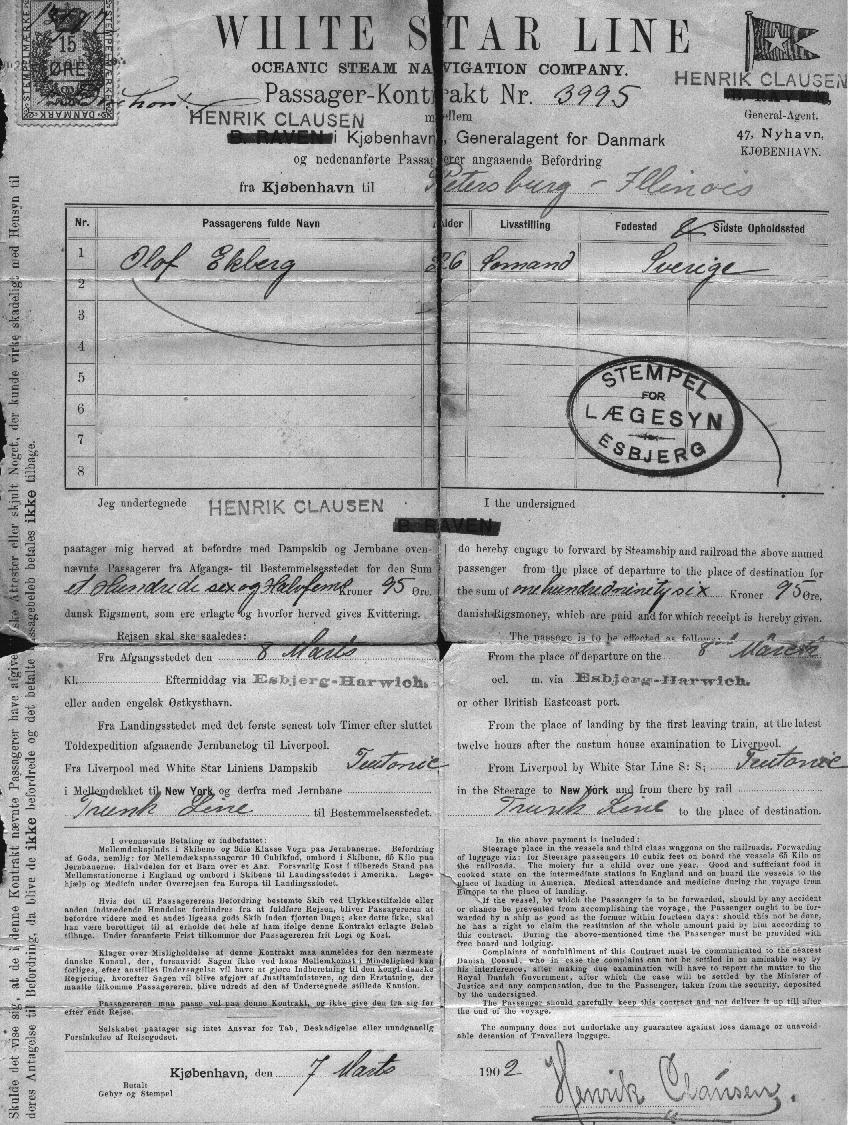
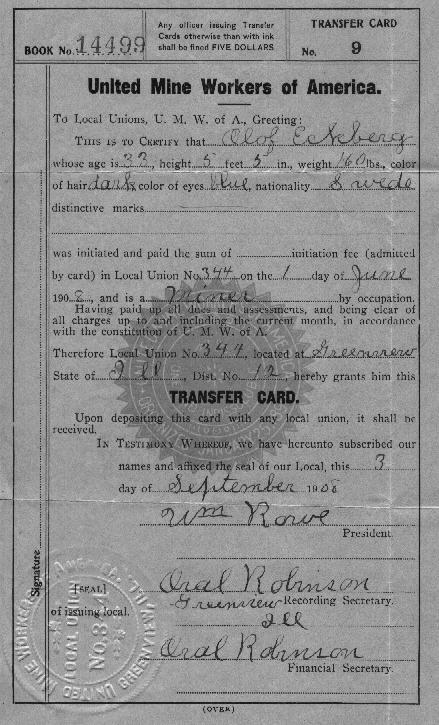
Olof came to America in March, 1902 and, according to his ticket , went directly to Petersberg, Illinois, and probably immediately went to work in the coal mines. Ida came to America, apparently in 1903, and though how and when she got there isn't clear, by 1905 she was also in the area, working as a housekeeper. We don't know with certainty if Olof and Ida knew each other in Sweden but it seems likely that they did as both families lived in the same small village of Almarod. Although Olof was seven years older and probably did not attend school with Ida, he no doubt visited his parents between ship voyages and must have known Ida. Whether they planned their emigration to America together is not known however.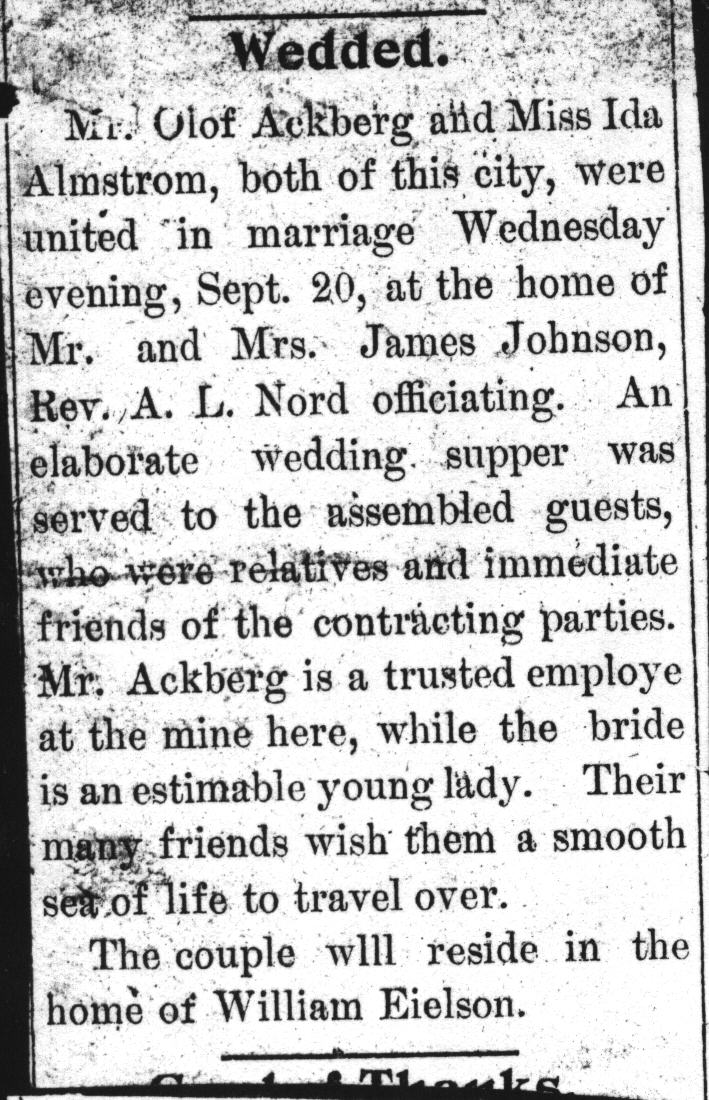
Within a very few years of their emigration to America Ida and Olof were wed in Greenview, Illinois, on September 21, 1905. The ceremony was performed in the home of Mr. and Mrs. James Johnson and the vows were solemnized by Reverend Axel Leonard Nord of the Swedish Mission Church. After their wedding Olof and Ida lived for a time in the home of William Eielson.
By 1907, Olof was working in the mines of the nearby Middleton Coal and Mining Company. We know a great deal about Olof's and the family's affairs for the next 25 years as Olof kept a "day book" in which he recorded many financial transactions that occurred on an almost daily basis.
In March of 1907, Olof was being paid. $2.56 a day for his work at the mines, doing unspecified "company work," but he was apparently not in the mines for this company until May of that year. Until that time he was working 6-12 days in a row and rarely had a full weekend off. He was paid every two weeks, usually about $30-$35 per check, and from that check he paid the company $4.17 for house rent, 50 cents for oil, 25-35 cents for union dues, an occasional cap for 25 cents, and more.
Beginning in May 1907 Olof began mining coal and kept a record of the number of cars and tons of coal he mined. He continued to keep track of his expenses and it appears that he bought all his supplies for mining from the company store. His pay was docked for pick handles, at 15 cents each, wedges at 35 cents each, balls of cotton for 5 cents, smithing charges to repair his tools, plus fees he had to pay the weighman, the shot firer and the union. Despite these expenses, Olof worked fewer days but was able, most weeks to make about the same amount of money or more as he did doing the "company work" at $2.56 a day.
There were times, however, when the mines closed or workers were not needed. When he couldn't work, he didn't get paid. One day the mine's ventilation fan broke and so the workers were sent home without any pay. Other days there were no coal cars available to be loaded and so no work was done. Other days they were simply laid off, according to Olof's notes.
These labor practices sound unfair and were apparently untenable to Olof and his fellow union workers as they went on strike in April 1908. They stayed on strike, and were not paid at least until May 27th when Olof returned to the mines in Greenview to do "company work," again for $2.56 a day. He did this for a while but apparently decided he could do better in farming and so sometime in 1909 or 1910 began life as a tenant farmer in Bureau County, Illinois.

 View My Guestbook